Thursday, October 25, 2012

No GMO's for These Floyd County Farmers


I just had an interesting conversation with Todd Howard, my friend and mentor. He said he understands why farmers would be drawn to planting GMO’s. Let me put his comment in context.
Gary and Todd at the Farmer's Market

Todd and his business partner, Gary Hicks, farm on two plots of land which consist of about six acres total. For the last two weeks they have been clearing, tilling and putting in manure and cover crop all to replenish the soil. This week alone they have added four tons of manure to their soil. That’s a lot of manure. (I’m just saying what you all are thinking) and Todd said it sure didn't go very far.

The process went like this. Drive your truck to the stable. Get out and start shoveling cuz there is no backhoe or farm hand to load your truck, which by the way is your farm truck not a dump truck so when you get back to the garden you have to do the whole thing again in reverse. Todd and Gary decided to fix the manure spreader to make the spreading a bit easier. Five hours later it was fixed and loaded and hooked up to the tractor and ten minutes later it was broke again. So then it was unload the spreader and spread it all by hand. Then you till it in which is easy cuz you have a tiller on your tractor except the yolk on the tiller breaks so you spend another three hours fixing that and start tilling again and then fixing it again and finally you can spread your cover crop. And you are doing all this to feed the soil. Of course, it would be easier to use chemicals than go through all this labor intensive nurturing of the earth.

Real Food!!
So why do Todd & Gary and the Grow Appalachia family do all this hard work? So that when they sink their teeth into the sweetest corn they every tasted or make a pot of hot soup this winter from vegetables they canned themselves they know they are eating real food. No chemical additives, no genetic alterations, no hormones. Just food and for Todd, Gary and lots of folks reading this blog post, that’s worth the effort.

So here's to the hard working farmer. Thanks!! Sr. KC

Wednesday, October 24, 2012

Baby Leek! ~ More fall planting and tilling in Abingdon, VA

Heather here.

Our focus right now is recruiting participants for next year.

I've been handing out flyers at the food pantry and the food pantry staff distributes them as well.


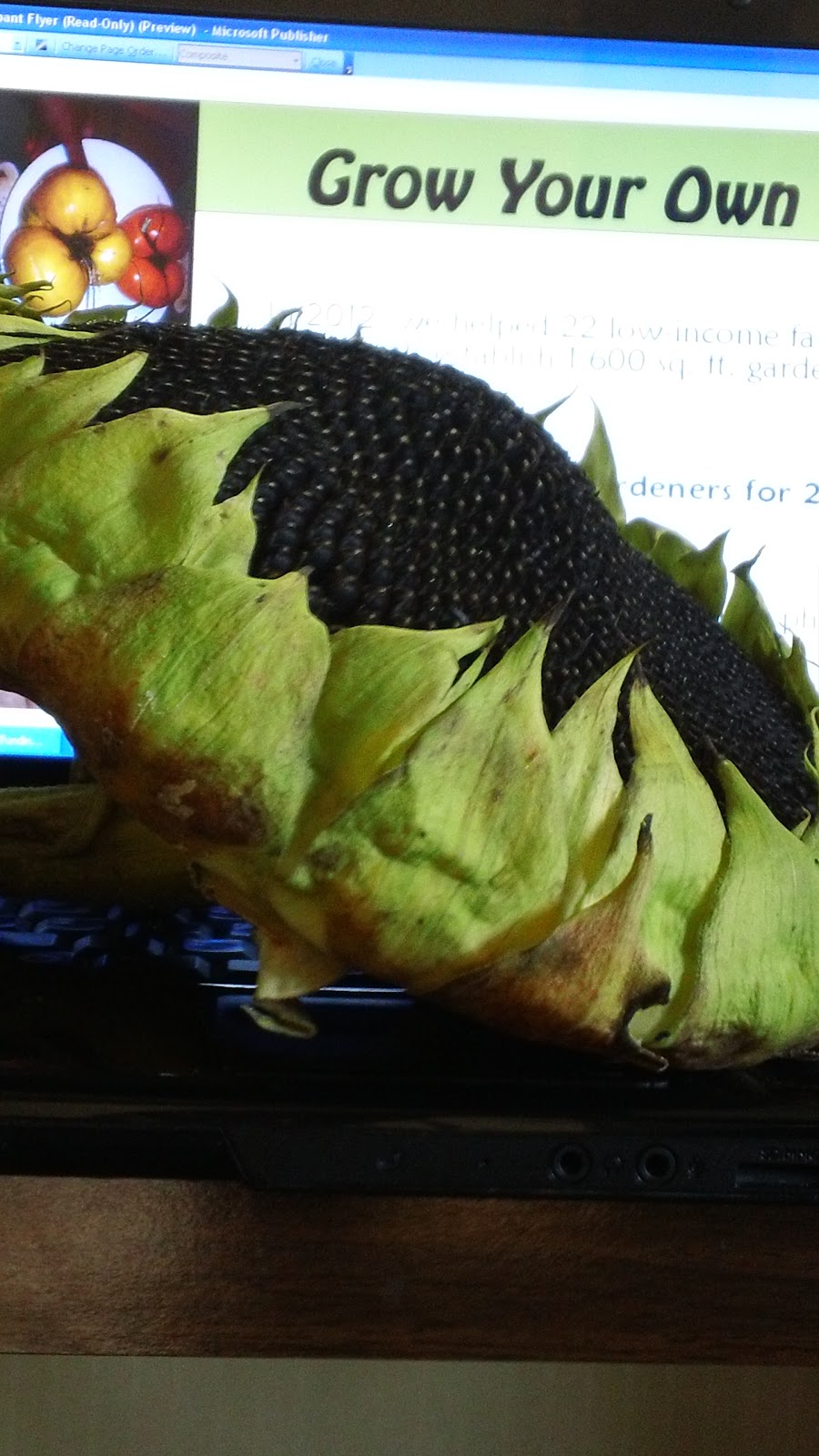
The flyer, and a lovely sunflower full of seed for next year (!)


I tilled up more of the garden and we seeded Austrian Winter Peas, and planted leeks, shallots, and lettuce. We will put bales of straw around the lettuce and prop a window on top for a makeshift coldframe. 


We shoveled all the tilled-up soil from the pathway and made a large mound, hoed 2 furrows and planted the little baby leeks 6'' apart. As they grow, we will rake soil into the furrows. We will also mulch the crap out of the leeks and shallots to aid in their over-wintering experience. 

Little lettuce squares


Before, and during, the tilling I was hemming and hawing and getting a bit worried and out of sorts as I always do when I think about soil compaction, all the different schools of thought on tilling...questioning my relationship to the soil and how much I really understand, but one of our volunteers, Debbie, actually took a photo of the soil to send to her friend as she said this was some of the best soil she's seen and she wanted to "gloat about how lucky [she] is to get to garden in it". 


Our garlic arrived...all 8 varieties. So excited. Need to do some onion research...

And our oats keep on keepin on.  


That's it that's all! 

Monday, October 22, 2012

We Beat the Deer ---- Chad Brock ----- Red Bird Mission

Earlier in the growing season I posted a blog on how our beautiful garden became a food plot for deer. Well turns out with a few cane poles some bailing string and a little hard work we still had some success with our garden.

I took some cane poles and some bailing string and raised my fence to around 7-8 feet high. I just ran a string all the way around the garden every foot apart until I got it high enough that deer wouldn't be so eager to jump over it. Then I took some old shopping bags and tied to the string and let them wave around in the wind. This was nothing pretty to look at but it confused the deer, the motion of the bags kept them backed off . No more deer.

After I seen that the deer had quit coming in the garden, I wanted to replant some sweet corn seed, I wondered if it would have time to make it seeing as it was already July 20th, but I chose a variety with an early maturity date (serendipity) and took a chance on it.
It done pretty good, last week we harvested, a couple bushel of six inch ears that seemed sweeter than any summer corn I can remember. This is something I plan on trying every year, a second run of sweet corn.

Sweet Corn harvested 10/10/2012


I also planted some Blue Lake 274 bush beans that produced really well,we planted four 25 ft. rows that produced about 4 bushel.
Our tomatoes also recovered from being mowed down , they became real bushy with lots of suckers but produced real well, we are still getting a few ripe tomatoes off of them. Our peppers done great, produced more than we could ever get rid of so we plan on drying them and crushing them and using them for spray next year to keep back the deer and rabbits.
 So as  the old saying goes "If at first you don't succeed try, try again".


Tomatoes harvested 10/10/2012


Friday, October 19, 2012

Sweet Sorghum of Pine Mountain~ Kathleen Powers


Maggie presses the cane with
 the help of GA participants
   This year, with the supervision of one of our very knowledgeable Grow Appalachia participants, we grew a crop of sweet sorghum at the Settlement School. Given that, (1) we were a bit late planting our sorghum, (2)we planted it in the wettest part of the garden, and (3)we neglected to keep it well weeded and thinned out, we were a bit worried that it wouldn't fully mature and that our efforts (or lack thereof) would be for naught. Luckily, we let the sorghum do its thing and by early October we had cane that was ready to be harvested and processed into syrup! At our fall harvest festival we pressed the cane and started the process of boiling down the juice, in the end we came out with one delicious quart of sorghum!

Our quart of sorghum!
   Sorghum is a crop that has been traditionally grown in Kentucky as far back as the mid 1800’s, Kentucky is now one of 8 states in the southeast and Midwest producing 90% of the United States total sorghum output. Sorghum is a great crop for many Kentucky farmers because it does well in the loam and sandy loam soils that are common in the state. Another ease of growing benefit is that sweet sorghum does NOT require high amounts of organic matter to produce a good crop for syrup. One of the greatest benefits of growing sweet sorghum is its value of about $2000 per acre. Sweet Sorghum as a cash crop is a great example of how keeping it local can really work; most sorghum growers tend to be small producers who see their crop from seed to syrup, and then to a local market; the work and profit of growing sorghum stays within the community and directly benefits those who put the work into producing it. Sorghum is definitely not something that you see filling grocery store shelves identified by the labels of numerous large commercial companies, I for one had never tasted (or heard of) sorghum in my life before coming to KY. 

Seed heads from the sorghum cane
   Sweet sorghum is just one of many varieties of sorghum grown in Kentucky. Sorghum crops can also be used as grain and forage feed for animals, as an ethanol/biofuel source, the grain can be ground into a gluten free flour for cooking and baking, and even popped like popcorn, who knew sorghum was such a versatile crop!

And a couple pictures from the fall harvest festival!
Pumpkin carving
mmm pumpkin guts

Thursday, October 18, 2012

Special Guest Speaker on High Tunnel: Tina

Wayne Riley whom is the Laurel County Grow App. coordinator invited a special guest speaker to come to our meeting on Tuesday night. His name is Doug McIntosh, he is a soil sample specialist with the USDA. He spoke to the group about high tunnel benefits, having fresh vegetables throughout the winter months, less bugs, more disease resistance to the plants.  He discussed having a high tunnel that is movable to rotate sites. Very informative and useful information. Handouts were passed out with even more information. He ended the meeting with a statement "Know your farmer...know your food". 

                                       Wayne Riley and guest Doug McIntosh

 
Doug and his wife Betty.
 
 
We were all very interested in this topic and learned alot about it.

 
Also I wanted to add the last of the community garden's summer harvest.  Many different types of peppers. These will be donated to Laurel Heights and shelters.


These are some grafted tomatoes that Wayne grew at the LCAAHC.


Mini pumpkins that are mainly used for Fall decorating. One of our Grow App. participants grew these and brought them in to share. Hopefully many of them will save the seeds and plant some in their gardens next year.
 

Harvest Party Recap!

Post by Corissa | Photos by Ralph
Bluegrass Domestic Violence Program

Last month we invited the community to a Harvest Party to discover and explore the farm and healing gardens. Staff and residents worked all week to make the shelter and grounds sparkle for our visitors. About a hundred people attended the event on that breezy end-of-summer day. Some party guests were familiar with the farm and stopped by to show their support. For others, the party was their first introduction to the amazing work we're doing on the farm.
Harvest Party guests begin to arrive.
Everyone enjoyed farm-to-table treats featuring our tomatoes, basil, and honey. One shelter resident made a big dish of her soon-to-be famous spicy salsa to share with party-goers. Tours highlighted how the farm and shelter work together to provide meaningful avenues of healing for survivors of intimate partner abuse.


We even had a special guest - Congressman Ben Chandler - stop by to show his support.


Business Lexington wrote a great article about the event and farm. One line reads: "Those who participate in the garden — and kids love it too — say they feel as if they are part of something bigger than themselves, a part of a community..." You can read the complete article here.

The community interest and support of our farm is really growing. Thanks to everyone who helped make our first Harvest Party a big success!

Henderson Settlement/ White Oak Happenings ~ Jackie

Sarah's (aged 11) Garden


Way back in the spring , Sarah, my next door neighbor, said to me, " School is almost out and I'm going to be sooo bored with nothing to do all summer". I asked , " Would you like to grow a garden?" She said, " I can't grow a garden, I don't know how! " I said, "I think I might be able to help you with that!
After discussing Grow Appalachia with Sarah's mom and explaining the program to Sarah, her mom agreed that growing a garden would be a great learning experience  for Sarah  and her whole family. Plus they would have fresh vegetables to eat!
Planting Tomatoes
 Sarah's mom remembered working in the garden when she was a little girl but had never planted her own garden. She was excited for Sarah to have the opportunity to learn how to grow a garden, however, we made sure that Sarah understood that the garden would be her responsibility . After discussing the space available for a garden and size of the garden, and what she might like to grow in the garden we decided that a raised bed garden would probably work best.
Sarah and her Dad built the raised bed and dug up soil to put in the raised bed,
she then planted tomatoes, okra and peppers.
Sarah had hoped to be able to sell some of her vegetables at our Farmers Market but the family ended up eating or giving away the vegetables she grew.


Learning how to can tomatoes with other Grow Appalachia participants


Sarah's Story

This spring I planted my first garden. It was a lot of work, but I had help from my mom and dad and Grow Appalachia. The hardest part was digging up the grass and then putting down the top soil. After that it got a lot easier. Jackie brought me tomatoes, peppers, and okra to plant. Mom showed me how to dig a hole and put in the plants and water. After that I had to keep them watered and pull out any weeds. I was really excited when the plants started to bloom and I was very happy the day I picked my first tomato. I shared my harvest with my whole family. Overall it was a great experience and I want to do it again next spring.


Weeding and Harvesting the garden