Friday, July 6, 2012

Each plant contains the moon and the stars ~ Abingdon, VA

Heather here.

There may be an elephant in the garden.
Every time we come out, the peanut plants are freshly nibbled, while all other plants remain unscathed. 
If there is an elephant coming into the garden, he is extremely graceful for nothing has been trampled. It is possible he is sending in rabbit scouts to bring him back tender leaflets and sweet yellow blossoms. Or, there is an outside chance rabbits are coming in as free agents. 

In any event, it seems the peanuts have become a trap crop. 

Rabbits aside, the main scourge upon us at this time is Japanese Beetles. Of all the insects I have come across, I find their personalities the least appealing. As a whole, the population seems pretty dumb. The way they splay their legs out and fall all over the place...geeze beetles. They devoured our corn silks. I believe the silks were around long enough for pollination to still take place, but I don't know for sure. I am currently researching organic methods for controlling them. 

This week we planted a second succession of watermelon. Our first succession is doing wonderful--fuzzy tendrils with lots of blossoms and tiny green globes of possibility. Nora, Jody, and I worked up the bed as a team, adding compost and hilling up mounds. While working we analyzed life in your twenties, rainbow gathering, and the growth cycle of a peanut. I always have scintillating conversations with my garden girls. 

We harvested cucumbers and beans for the first time, and our preparing for our Fall Crops class on July 12th. 


That's it for now!  


It's Thrifty, It's Patriotic, Plant Today! ~Pine Mountain, Maggie Ashmore


Independence Day is a wonderful holiday that captures the spirit of our country and the essence of summer in the hearts and minds of many. While we are celebrating the freedoms we have in this country and the height of summer activities I would like to reflect on the independence that raising a garden provides. Raising a garden and providing for yourself and community has long since been viewed as good citizenship.

Thomas Jefferson famously said, “Cultivators of the earth are the most valuable citizens. They are the most vigorous, the most independent, the most virtuous, and they are tied to their country and wedded to its liberty and interests by the most lasting bonds” and “Agriculture…is our wisest pursuit, because it will in the end contribute most to real wealth, good morals and happiness.”

And don’t forget about Victory gardens. During WWII 20 million Americans planted gardens wherever they could find space. Gardening went through a renaissance during the war as families worked to make their rations go farther and do their patriotic duty. However, as WWII ended the U.S. government ended their promotion of home gardens and home food production decreased as the decades wore on, until families lost the knowledge and desire to begin their own gardens.

Now the local foods movement has brought gardening back into view and Grow Appalachia has given many families the wonderful opportunity to grow their own “victory gardens”, pushing us to once again have pride in knowing our land, feeding our bodies, and envisioning a more self-reliant community.  During this 4th of July week I’d like to show you all some pictures we've taken this spring and summer of the beautiful gardens giving us all some more independence. 

Tevis Turner's beautiful garden

The first string on Tevis' Florida weave

Maggie works on  the Florida weave while James checks his pepper plants


Beautiful squash blossoms

Sweet potato tires!


Baby beans!


McKenzie knows how to stay cool on these hot summer days!


After deciding that a bathing suit was more suitable attire for playing the in water hydrant, McKenzie helps harvest the first potatoes of the season!


Big Ugly Community Center Grow Appalachia

Hello Everyone and hope everyone is doing well.
     As we come into July we are all now starting to enjoy our gardens.  Even though we have had a really
dry season.  I gardens have been doing well.
     All the particpants are very thankful for the Grow Appalachia program, and all it has brung into
our community.
     The particpants of the program we all very excitied to receive the pesticides for their gardens.  And some we were ready to apply the same day.
    Allthough we have had a really dry season to start as I said eariler I am very please to say I our
gardens are producing vegetables that are wonderful not only tasting but in size.
     Old timer tips: Keeping hands Soft: Continous work in the garden makes the hand grimy and hard.
  Next time you come in from the garden, work up a soapy lather in your hands and add about half a teaspoon of ordinary sugar which has been moistned. This treatment not only cleans the hands, but leaves them beautiful and soft.
Protect your smaller tools: Your smaller garden tools can be protected from rusting by keeping a pail of sand near the garage or cellar door and plunging them into the sand when through with them.

Tuesday, July 3, 2012

Sharing

 Hey this is Sue G. from the LMU project.  Last week I had my grandson helping at the garden too.  I agree it's such wonderful thing to share.  He helped the kids plant pumpkins, melons, and squash.  then we went to the other part of  the garden to harvest our beans, peas and zuchinni from our raised beds.  I asked him to do the picking and went off to finish digging my garlic.  He came over with the bag and was so delighted with it all especially the long gorgeous purple pole beans.  We then went to the potato field with a 5 gallon bucket and began digging.  the 1st plant had to have had 5 lbs of red potatoes.  We got some of all 3 kinds we had, the bucket was almost full and I said thats enough.  He said just 1 more plant, but I think he dug at least a couple more.  Our bucket was heaped and we were heaped with delight.  What a lovely evening of sharing the garden work with other members and the joy of the harvest.  We've brought this great food to eat at our cottage in Michigan and are happily cooking it for all our visiting family.  What a blessing!

Monday, July 2, 2012

Greetings from Project Worth Outreach in Menifee County, Kentucky.  My name is Alex Sanders and I am an AmeriCorps VISTA. 

It has been extremely hot and dry in the month of June.  All of our participants are having trouble with their garden because of the weather conditions.  Most of the terrian here is very rugged and we depend heavily on rain.  With the lack of rain our participants are trying to be creative but not having a lot of success.  Most of their gardens are located away from their homes and therefore they cannot run a hose that far.  Some are carrying water in buckets but this is time consuming and hot work.  To most of the participant's credit they are doing everything they can to take care of their gardens.  From what I have seen on my home visits the gardens still look pretty good considering the weather conditions.  I just keep telling them to hang in there and keep a positive attitude.

Listed below are a couple of statements from our participants.

Christine Deaton:     The Grow Appalachia Gardening Project has given my grandchildren something to do with me.  They are 10 and 6 years old.  They have enjoyed working with me in my garden.  They ask a lot of questions.  Thank you Project Worth Outreach and Grow Appalachia for giving us this time together.

Loretta Young:     I would like to thank Project Worth Outreach and Grow Appalachia Garden Project for everything they have done for me and my family.  They gave me a chance to have a nice garden and to teach my grandchildren how to take care of plants and to know the meaning of raising their own food.  Over this past weekend a friend come to my home and went to my garden with me to get potatoes.  Angie was standing there looking at the potato vines with a strange look on her face.  When I asked her what was wrong she asked where the potatoes were because she couldn't find them on top of the vine.  I laughed and said honey they do not grow on top of the vine they grow in the ground.   This girl is 25 years old and has lived in the country all of her life.  This just goes to show you how much we need programs like Grow Appalachia to help us teach our children and grandchildren about where food comes from.  I just want to thank Grow Appalachia and Project Worth Outreach for making this happen for me.

Our next meeting will be at 6 PM on July 23 and we will be having a training class on the measurement of food followed by a cookout for all of our participants.  Let's hope for some cooler weather and some consistent rain.  Please find this week's recipe below.


Escalloped Cabbage


1 medium head of cabbage
1 pint milk
2 tablespoons butter
3 tablespoons flour
1/2 cup bread crumbs
1/2 cup shredded cheese  {optional}
salt and pepper to taste


Cook cabbage in boiling water for a few minutes.  In medium bowl mix milk, butter and flour.  Stir cooked and drained cabbage into sauce.  Place into baking dish.  Cover with bread crumbs.  Bake at 350 degrees for 30 to 35 minutes or until golden brown on top.  This is very good.  I doesn't taste like cabbage.

Florene Earlywine


Note:    I submit these recipes as they are given to me.  Please feel free to substitute healthy ingredients whenever possible.


That's about it from Project Worth Outreach for now.  I hope everyone has a great week.  Please pray for cooler weather and rain. 

Dinner at Cowan Creek Mountain Music School

Dinner on the Grounds at Cowan Community Center


This past week, Cowan Community Center hosted its eleventh annual Cowan Creek Mountain Music School, drawing participants from as far away as Utah, Maine, and Chicago to learn traditional mountain music.  One of the evenings, the Grow Appalachia program joined the festivities providing dinner, serving a meal made of garden-grown vegetables and traditional local food.  Music school participants and Grow Appalachia gardeners alike enjoyed the delicious meal.  A basket for donations for the dinner was set out at the dinner, and $200 was donated for mountain music school.  This money will provide a "Grow Appalachia Scholarship" for one student next year at the music school.  Music school participants sang for their supper, providing the music for the following square dance which was enjoyed by all.

Part of the entertainment for the evening included a walking path around the community center, lined with the rain barrels that Grow Appalachia participants painted the week before.  Strolling through the woods it was a pleasant evening to admire the artistry and talent of our gardeners!  The water barrels are literally pieces of artwork: art at work.

We were lucky to be joined by David Cooke, Grow Appalachia director from Berea College, for this wonderful evening, and everybody was excited to see the man who made it all happen.  Just as Three Sisters Gardening grows corn, beans, and squash in perfect harmony, music, food, and community came together that night for peace, love and happiness.


David Cooke (Grow Appalachia Director, Berea College), Carol Ison (Director of Cowan Community Action Group), Nell Fields (President of Cowan Community Action Group), and Valerie Horn (Grow Appalachia Coordinator for the Cowan Community Center) make a short presentation before dinner is served.  David was presented with a handmade quilt, tacked by our very own gardener Hazel Rayburn, and canned vegetables and fruit from Becky Collins.


A water barrel on the walking path, painted by Lydia Thurman.
The beautiful spread: chicken and dumplings, made by Carol Ison.
Rondall and Sharon Meade, Grow Appalachia gardeners, enjoy the company and food. 
Everybody is excited or a delicious meal.
Swing your partner 'round and 'round!


Sunday, July 1, 2012

Finding New Ways to Water During the Drought...Tina

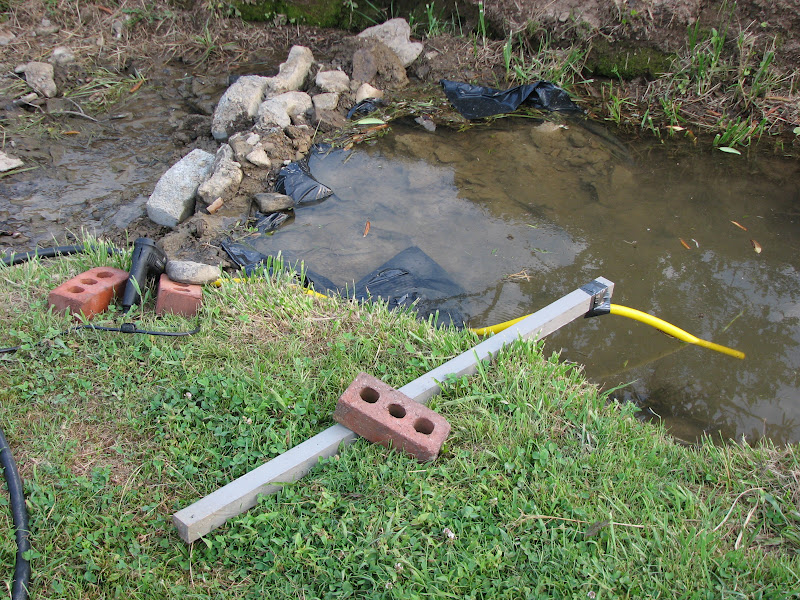
With all the problems that the drought is starting to have on our gardens, one of our participants is coming up with some ways to water without the use of using water from the city system. They were using a rain barrel but since no rain, it has become useless. They have a creek that runs by their home and they were trying to find the cheapest way to set up their watering system. They found a water pump for 7.99 at Tractor Supply that uses a drill to run it. It is set up and all they have to do is plug it in everyday when they water.


They had to dam up the creek because it is very low on water.


This pump is running through 150 feet of water hose and it does have a pretty good stream of water for a cheaper pump. They calculated the energy costs to run the drill and it costs approx. .10 an hour to run. They have been watering about 3 hours every other day and have reported very little difference on their electric bill.


If the drought continues they will have to move to a bigger creek that is farther from their home because the smaller creek will dry up soon.