Friday, August 17, 2012

Scott County Grow Appalachia

   Black Gold     -    C O M P O S T    -

Composting is taking organic waste, yard trimmings and kitchen scraps and converting it through decomposition into a free source of soil amendments and a natural fertilizer.  Using compost we build up our soil by adding important nutrients back to the soil that get depleted during our gardens growing season. We just can’t get the same results from chemical fertilizers.

It is estimated by the EPA that 20% of all landfill use is organic materials that we should be composting.  By composting, we can significantly reduce landfill space..

To make compost it requires green matter such as food scraps grass clippings which will add nitrogen, and brown matter such as leaves or saw dust that add carbon. With water, oxygen and time we will have our compost.  It is important that we layer the greens and the browns then occasionally stir it with a pitched fork to get oxygen into the pile the more you work your pile the faster it will decompose for you.

Creating a compost bin or area is simple.  It doesn’t require much time, space or money.  Compost areas ideally should be close to the garden.  There are a variety of materials that can by used to make a compost bin, such as cinder blocks, woven wire fence, lattice, etc..  There are also many compost bins that you can purchase commercially.

What should be added to your compost bin?

·         Vegetable peels and scraps
·         Fruit scraps
·         Coffee grounds with filter
·         Tea bags
·         Egg shells
·         Watermelon  rinds cut into pieces
·         Grass clippings
·         Leaves
·         Spent flowers and plants
·         Weeds if it has not seeded

Things that should never be composted:

·         Meat or meat scraps
·         Bones
·         Fats or oils
·         Salad dressings
.         Dairy Products


Composting Class

We offered a composting class following our participants meeting this week.  We only have a few participants that have composted before.  After the class, most of them said that they were going to begin composting.


One of our participants, Ms. Lackey, helped to teach the class.  She is very knowledgeable about composting and has many years of experience.  She did a great job!  She also recorded a video on composting from her garden. 


                   Participant of the Week   
                                        Ms. Crabtree


We are very proud to name Ms. Crabtree our garden participant of the week.  She is very enthusiastic, hard working, and her positive energy is inspiring.  Even though she works full time and has two teenage daughters, she is quick to volunteer to help the Grow Appalachia team.

Her feelings about Grow Appalachia in her own words 

"Five years ago, my husband and I decided to plant a garden for various reasons such as finances, nutrients, the love of fresh vegetables, to relieve stress etc. My husband was a truck driver so he was only home on the weekends to help with the garden.  He would normally plow and till the garden and sometimes help plant, while I would take care of the garden and harvest what it would produce. 

May of last year I lost my husband to a massive heart attack. Without his help to plow and till the garden for me, I was unable to have a garden. This year thanks to you and the Grow Appalachian Project that you have provided to Scott County, not only did I get my garden plowed and tilled for me, but I also had seeds, plants and fertilizer provided to me as well.

This has been a very stressful year for my two teenage daughters and me. However, thanks to this program I have been able to work in my very own garden and really enjoy the peace and relaxation that working in the garden gives me, which helps to relieve a lot of the stress. Your program has also blessed us by providing us with the help to produce a garden that not only has produced vegetables for ourselves but also have been able to provide vegetables for several other needy families in our community." 


Ms. Crabtree's donation to a local food bank


A Tasty New Way to Prepare your Plots: Lasagna Gardening ~ Pine Mountain, Kathleen Powers


     Sounds pretty good right? Plant lots of tomatoes, eggplant, maybe some spinach…. But cheese doesn’t grow!  And where does the pasta come from? Well lasagna gardening is not in fact about growing the ingredients for a tasty lasagna, but rather, a nontraditional organic gardening method that relies on a layering method called sheet composting.
     One of the greatest benefits of the lasagna gardening method is that it does not require any digging or tilling. This makes it an ideal practice for beginning gardeners, elderly gardeners, or those who simply do not have access to equipment to break ground and work the soil. Lasagna gardening can also be a relatively low cost method of gardening, using recycled and found materials.
     So how does this lasagna gardening thing work? you ask, well I will do my best to give you a rundown of the basics of Lasagna Gardening.
     Though it may not seem like it is already that time of year, fall is just around the corner and soon it will be time to start putting your garden to bed and preparing for the winter. Fall however is also a great time to get started with new garden plots for the next season because there is a bounty of organic material available and the winter months will allow ample time for your organic material to break down and leave you with a ready to plant plot by the time spring arrives.
Two garden plots ready to decompose through the winter

Step 1: Choose your garden area and put down a layer of cardboard over the entire area, make sure to overlap the cardboard so that no weeds or grass can creep through the cracks. Then thoroughly wet down the cardboard so that it will stay in place. You do not need to till/dig up the garden space at all because the cardboard will kill all grass and weeds and slowly break down the dense top layer of soil.

Step 2: Put down your first “lasagna” layer on top of the cardboard. This layer should be 2-3 inches thick and made up of water absorbent material such as dead leaves, straw, peat moss etc.

Step 3: Add a second layer made up of greener material, such as grass clippings, veggie scraps, garden trimmings, etc.

Step 4: continue to add layers alternating between green and brown until your garden spot is covered with layers that are about 2 feet in height. Layers can be made up of just about any organic material such as leaves, grass clippings, manure, compost, coffee grounds, shredded paper, pine needles, etc. Just make sure that you are not adding any diseased garden plants to your piles or you will have future problems. You can also add necessary soil amendments such as lime and wood ash to the layers to get a head start on a healthy garden.

Layers of a lasagna garden
Step 5: leave it all to decompose over the winter months. By the time you are ready to plant in the spring the layers will have reduced in height to just several inches of loose rich soil.

Step 6: Planting! When you are ready to plant simply dig down as deep as necessary in the soil and plant to your heart’s desire.

Step 7: Once you have planted it is very helpful to apply a layer of mulch to the entire garden. This will keep weeds to a minimum and help the soil retain water. Mulch can be made from straw, grass clippings, leaves, shredded paper, etc.


Benefits of Lasagna Gardening/Sheet Composting
• No tilling, digging, or large equipment necessary
•Few weeds will grow if you properly mulch
•Low cost
• Nutrient rich soil

Patricia Lanza is the gardener who conceived of the lasagna gardening system as I have described, here is her first book on the topic and an article written by her that you can access online:

Lasagna Gardening: A New Layering System for Bountiful Gardens, No Digging, No Tilling, No Weeding, No Kidding!  By Patricia Lanza

http://www.motherearthnews.com/Organic-Gardening/1999-04-01/Lasagna-Gardening.aspx

Thursday, August 16, 2012

Henderson Settlement / White Oak Happenings ~ Jackie


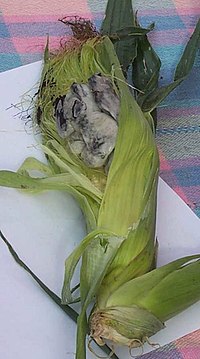
Have you ever seen corn that looked like this?

 Today one of the White Oak gardeners brought several ears of corn from her garden over to H.S. for us to look at because she didn't know what was happening to her corn. We showed the corn to our farm manager and he said, "That's Corn Smut".  When we asked , "What's that!" he said, it's a fungus that happens when there has been a drought and then it starts to rain.

According to Wikipedia, Corn Smut is a pathogenic plant fungus that causes smut disease on maize and teosinte. The fungus forms galls on all above-ground parts of the corn species. Although it can infect any part of the plant it usually enters the ovaries and replaces the normal kernals of the cobs with large, distorted tumors analogous to mushrooms. The spores give the cob a burned, scorched appearance. It grows during times of drought, (like we have just been through) growing best in a 78 to 93 temperature.

Smut feeds on the corn plant and decreases the yield. Usually, smut-infected crops are destroyed. Some farmers may also choose to prepare corn silage out of the smutted corn. It is most popular in Mexico, where it is known as huitlacoche and can be regularly found as an option in meals. The consumption of corn smut originates from ancient Aztec cuisine and is still considered a delicacy in Mexico, even being preserved and sold for a significantly higher price than corn.[12] For culinary use, the galls are harvested while still immature — fully mature galls are dry and almost entirely spore-filled. The immature galls, gathered two to three weeks after an ear of corn is infected, still retain moisture and, when cooked, have a flavor described as mushroom-like, sweet, savory, woody, and earthy. Flavor compounds include sotolon and vanillin, as well as the sugar glucose.

Meals on Wheels? ~by Erica at High Rocks

Sometimes cucumbers just get away from us.  A few days without picking and you can end up with a pithy, over-ripe monster on your vines.  What’s to be done with such a thing?  The Jacox community of Pocahontas County, WV has an answer.  NAS-CUKE!  Using recycled materials, they transformed cukes, zucs, and squash into racing machines this weekend in the first annual produce race.    Grow Appalachia-sponsored cars made a strong showing and their drivers ended up winning a slice of the prize chocolate zucchini cake. 


Mother Nature vs Vegetable Farmer

Todd and Gary at the Market

Sr. KC here. I just got off the phone with my friend and local farmer, Todd Howard. He has been a wonderful gift to us here at St Vincent’s Grow Appalachia program both in the Greenhouse Mentoring program and as a partner in the sustainable agriculture movement in Floyd County. He called to see if any of my families had some extra beans they wanted to sell at the Farmer’s Market this weekend. Another of Todd’s many jobs is market manager for the Floyd County Farmer’s Market. The market had its best week last week and he really wants to keep the momentum going. He has been selling produce he and his partner Gary grow in two bottoms here. That was until yesterday about 10:30 in the morning when the rain came.

He noticed the rain was coming down pretty hard and walked out on to his porch just as his partner drove up. They decided to go check on the garden at Open Fork which sets in a bottom. When they got there they saw the creek was full and moving fast but not too bad. Then they noticed water coming over into the garden and within fifteen minutes there was four foot of water in their main market garden. Here is a YouTube video of the water.Todd's Market garden

When I saw Crystal this morning she told me that Brushy, the hollow where she and several of my Grow Appalachia families live, got hit hard and most of the gardens were gone. I’ve made some calls but haven’t gotten through. They are probably out cleaning up. Crystal lost everything but maybe three rows of beans. Her sister-in-law lost three bottoms and the hay bottoms on Route 7 were all flooded.

Farming in the mountains is a tricky business. Most of the land is hillside and rocky except for the “bottoms” where the creeks run. There is soil there and most of it is fairly fertile. And most of the time, if you don’t get flooded in the spring rains, you do OK. The weather has been bizarre this year with August being wet instead of dry. And then when you add man-made obstacles like holding ponds on strip mines that fail…well you get flood.

Todd is a market farmer so after he gave himself an hour to feel sorry for himself, he and Gary are out salvaging what they can to put up and then planting some more fall crops. As far as my Brushy families, they have lived on this land for generations. That’s why we put up so much”, one woman told me, “in case we have a year where we can’t, we wont’ go hungry”.

Tuesday, August 14, 2012

Home Visits ---Chad Brock------ Red Bird Mission

  Here at Red Bird Mission we have been spending time visiting some of our participants gardens; helping with any problems, helping to plant some fall plants, and collecting harvest information.
I am finding that even though the dry conditions had slowed alot of the produce, overall yields are looking pretty good. I think the biggest problem we have had is blight and blossom end rot on their tomatoes. Mostly, everyone is harvesting from their tomatoes, but are forced to pick them a little early and let them ripen inside.
   Even here at Red Bird I have had alot of issues with this, and like alot of our participants I sprayed faithfully, left at least two feet between plants and pruned the plants to increase air circulation. But still had problems.  The last month or so here have been very wet; rain every couple of days, high humidity and heavy dew nightly. This is an ideal environment for these fungus diseases to explode.

  We are seeing an increase in both vendors and customers at our weekend farmers market here at Red Bird Mission and are providing a much bigger group with the access to fresh local grown organic vegetables and providing some income to local farmers in a very economically depressed area. The food voucher program provided to local, low income families through Grow Appalachia and the Red Bird Mission Food Security Project has been a big factor in boosting involvement and helping to reach this goal. We anticipate it to continue once everyone sees the benefits of this market.

Henry Ledford's Garden

Henry Ledford's Garden/ Muskmelon

Hilda Hacker's Garden

Hilda Hacker's Garden

Ray Wagers' beans

Ray Wagers' summer squash

Ray Wagers' corn

Sue Collins' garden

Preparing Faye's Garden to plant a late patch of bush beans 

Faye Caudill getting tractor ready 

Faye Caudill's Raised bed

Faye Caudill's Raised bed

Audrey Hollen's garden

Audrey's tomatoes

Planted mustard/turnips with Audrey Hollen

Demonstrated starting cole crops from seed for Audrey Hollen 

Demonstrated starting cole crops from seed for Audrey Hollen

Audrey Hollen Garden

Bradford Garden

Bradford Garden

Bradford Garden

Sandlin Garden

Sandlin Garden

Monday, August 13, 2012

Great food, great kids. ~by Erica at High Rocks

 
This week we visited the Marlinton Middle School garden to weed and lay donated sawdust in the paths.  Principal Joe Riley met us at the garden and shared his excitement about the project.  This lush garden will greet students when the return to school in two weeks.  

We helped out beginning gardener Lori with weeding, harvesting, and preparing the site for a new fence while sunflowers watched approvingly.   Her sugar-baby watermelons are coming in and we helped her pick two pecks of beets and carrots which she is planning to freeze and enjoy roasted this winter.   

We visited Vanessa's 2nd year Grow Appalachia garden where her daughter helped her spray a homemade concoction of garlic, cayenne, and soap to ward of those that would eat her bean leaves.   We worried that late blight had gotten her tomatoes, but the diagnosis from the WVU extension office was septoria leaf spot and fruit anthracnose—not great, but at least she can still get some tomatoes from infected plants.  We sprayed Serenade on the tomatoes to check the spread.  Our wet nights and misty mornings haven’t made for the best conditions for tomatoes recently.  Next year we will be advising gardeners to leave more space between their tomatoes and prune them to promote better air flow. 

We had fun in the Pearl Buck garden with Hillsboro Elementary students, harvesting and planting lettuce.   The kids that came to help left with ears of corn and bags of beans and lettuce for dinner that night.