Tuesday, August 7, 2012

BDVP Make It Take It: Jam and Pickles: Jessica

We recently offered another installment of our Make It/ Take It series.  This month we decided to can blackberry jam and pickles from the garden.  Participants gathered together to make traditional low sugar jam.  As we warmed the berries on the stove everybody chopped cucumbers, peeled garlic and chopped peppers for our batch of home-made pickles. We didn't have any dill in the garden so we actually used basil for our pickles (which I have done in the past... and love!).      Most of our group participants had never done any home canning.  I wanted to let them know what a fun and easy project jam making can be. We really had a great time in the kitchen that day! We were able to make a big batch of a nice quality product and everyone got their own jar to keep. 


Our next official Make It/Take It class wil be held in a few weeks and we will be canning tomato sauce and making an enormous batch of pesto to freeze. In the meantime we are considering doing another pickling class and using up some of our beets and the rest of our cucumbers.  We will surely keep you all posted!

Jam........
Warming up the berries


Adding Sugar

Pickles.....
Wash em'


Chop em'
Pack em'


Pickle em'


Friday, August 3, 2012

Garden brings in greater community in Abingdon, VA

Heather here,

I had to spray Serenade this week and get those tomatoes back in line with some more trellising--they're sprawling all over the place like crazy. Some white flies moved in, which is very strange as they are usually a greenhouse pest. Reading up on the subject I've found you can vacuum them up. Something I think sounds awesome, but my cohort, Jody says, "Would you like to be vacuumed? I don't think the plants will like that." I have to think on that.

In any event, I pruned them back quite a bit to increase air flow and we'll see if the white flies become too insane...they have not caused a lot of damage so far but I don't want them to get out of hand. I might try neem oil. A participant was telling me that he uses it all over his beans and it helps a lot. I think it would be good to try first on the white flies before pyganic.

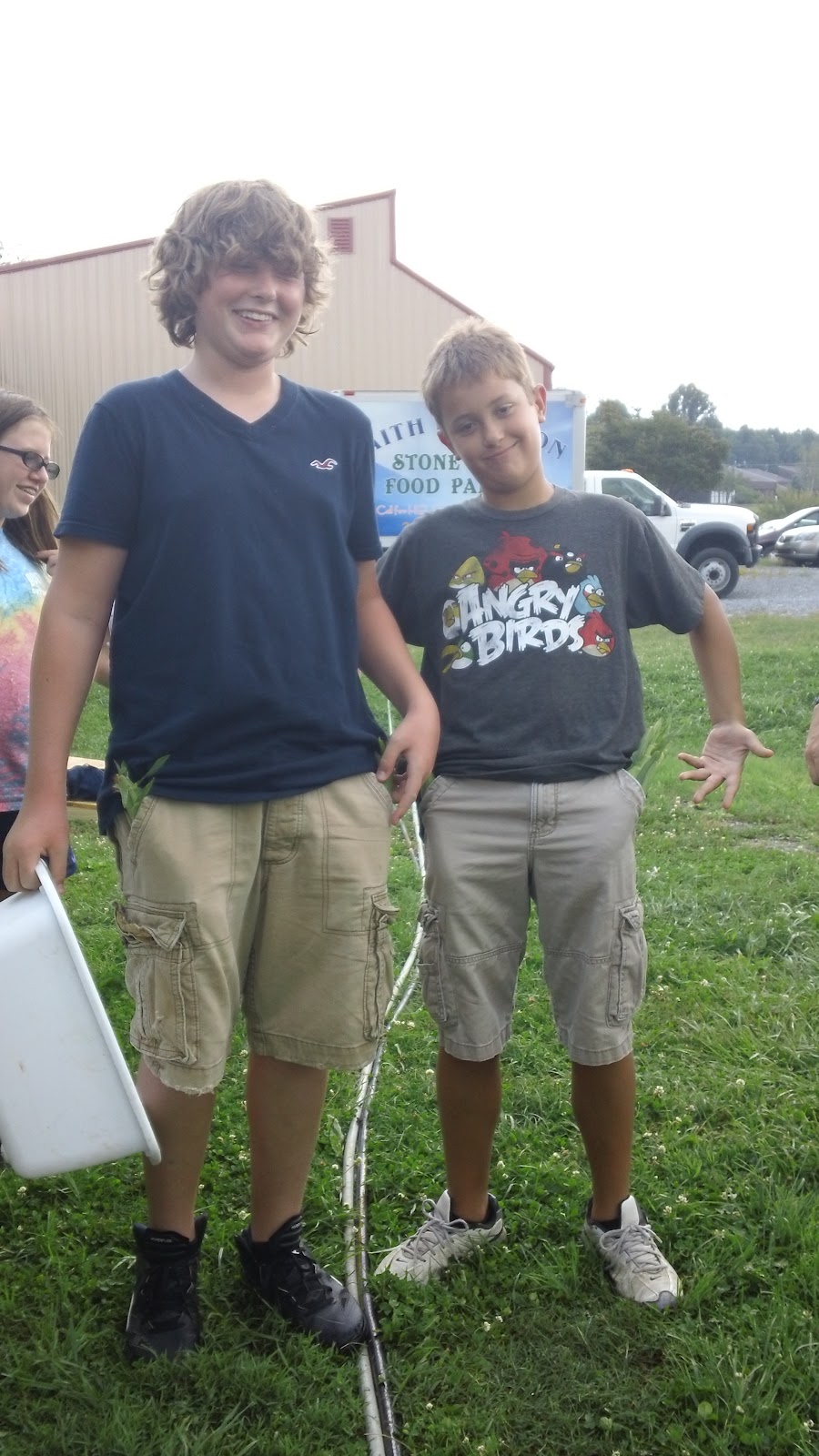
This week we had a local kids camp come out to work in the garden for the day and help us seed flats, harvest, and put up educational signs. We took a tour of the garden and learned a lot about plants and insects, eating edible flowers, tomatoes, and knocking on melons trying to guess if they were ready.


The kids loved running around the corn patch and thought it was funny when I explained the girl and boy parts of the corn plant. The kids were so into their corn that when we moved on to other activities they wanted to hold on to it and make sure no one took it.


There was a mystery winter squash here...I don't remember planting it, whatever it is!


We had a bean-picking race (I was happy to be off bean duty) and squished bean beetle larvae. 


We grew a bed of basil, genovese and black opal, but have had trouble getting anyone interested in it at the food pantry--even when we had a basil day where we brought in pesto to try and a lot of recipe ideas. Bummer! I don't want to give up yet on getting people on the basil train, because it is a green that grows through the heat that is SO good for you (vitamin K, magnesium, and special healing properties in all that essential oil), and you can freeze pesto and have green sauce all winter--I want people to like basil! But, we want to grow what people want to eat, too, so who knows. I am still thinking of good ideas to get people to try more produce. It was heartening though how excited the kids were to pick it and take some home. They all wanted a recipe/suggestions flyer and I hope they do cook with it with their families at home!

I love that while I'm talking about basil the kids in the back are playing with their corn...if vegetables are the distracting item I'm all for it. 


They are coming back next week so I'll get the scoop and see if anyone else has converted to basil-loving!


I've been taking more pictures of garden plants and weeds at various growth stages, as well as garden insects, friends and foes, at different growth stages--we hope to put together a useful training tool using the photos.


I did some more site visits this week and gathered more video footage.

We whacked 3 watermelons open after looking for a withered tendril, yellow spot, and knocking on them, but every single one was underripe! I am wondering if the watermelon's stem needs to be brown, not just the tendril across from it. I keep listening to watermelon thumping sounds on youtube and it is still hard for me to tell the difference. Does anyone have any sure-fire ways? I know cantaloupes should fall from the vine when you lift them up, and you should be able to smell the ends of the fruit, but I didn't think you could do that with watermelon...hmm.


That's it for now,

Heather

And the Summer Squash continues to Produce! : More creative ways to use your yellow squash ~ Pine Mountain, Deb Callahan


     The Grow Appalachia gardens of Pine Mountain are doing well, we could use a break from the rain but that’s getting to be old news isn’t it? Last week we held a food preservation workshop that was very successful and informative and this evening we will have our second local foods potluck of the season. For this potluck we ask everyone to bring a dish with ingredients raised, harvested, or collected within 100 miles of the Settlement School. Hopefully we will have an evening of lots of delicious fresh food and good conversation!

     The following blog post is written by Deb Callahan, one of our new Grow Appalachia participants (but already an experienced gardener) this year. Deb has a wonderful garden and is always bringing beautiful produce to share with us, now we can all enjoy some of Deb’s recipes and hopefully some of her good food tonight!
-Kathleen Powers

One of Deb's squash plants
     I planted a couple hills of summer “crookneck” squash a few years ago.  A lot of them went to waste because I was the only squash-eater in my household.  This year I was a little more ambitious in my gardening and planted 6 hills of squash.  What was I thinking - I am still the only squash-eater in my household! 

    After giving little yellow “care packages” to some of the neighbors, I found myself wondering what to do with all of this squash.  In May, I attended a Grow Appalachia workshop that demonstrated how to roast vegetables, so I thought I would give it a try using squash.  I sliced 4 of the smaller squash, an onion, 2 banana peppers, and diced a new potato into a bowl.  I drizzled a little oil over it, seasoned with Adobo seasoning, covered with a lid and shook it to coat the vegetables with the oil and seasoning.  I baked it in a hot oven (450 degrees) for about 20-30 minutes.  YUMMY!  I found a new favorite!
An impressive pumpkin in Deb's pumpkin patch

I’ve also found some recipes on the internet for squash bread and it is delicious! (See recipe below)


Summer Squash Bread

Ingredients
3 eggs, beaten
2 cups white sugar
1 cup vegetable oil
2 teaspoons vanilla extract
3 cups all-purpose flour
3 teaspoons baking powder
2 teaspoons ground cinnamon
2 teaspoons ground nutmeg
2 cups shredded/grated summer squash

Directions
Preheat oven to 325 degrees. Grease 2 loaf pans.

In a large bowl, use an electric mixer to beat the eggs until fluffy. Beat in the sugar, oil, and vanilla. Gradually mix in the flour, baking powder, cinnamon, and nutmeg. Fold in the squash. Transfer to the prepared baking dish.

Bake 45 minutes in the preheated oven, until a knife inserted in the center comes out clean.

I hope to be able to attend the Local Foods Potluck August 3rd at Pine Mountain Settlement School.  I plan to try out the Squash Cake recipe I found online and maybe take a bowl full of my roasted squash, too!

And just to showcase Deb's wonderful garden produce and cooking, here are pictures of the Chow Chow she recently canned
Before canning

After canning

Henderson Settlement / White Oak ~ Jackie

A proud Gardener! My very first ear of corn!
One of Henderson Settlements most valued resources are the volunteers from all over the United States who give up their time and energy to help the people of this region.
 One of these volunteers is our Ms Wenda who helps in the Food Pantry and assists with grant writing and other special projects.
Ms Wenda's garden


 When she heard about the Grow Appalachia Project she was very excited and wanted to be part of the Community Garden. We told her she could plant whatever she wanted to in her garden and so, like the little red hen, she did, all by herself!


PROJECT WORTH OUTREACH FEATURES GARDENER

Good morning, everyone.  This is Alex from Project Worth Outreach.  In this post I am really excited to introduce you to one of our exceptional gardeners.  His name is Jerry Redden.  During one of my rounds of garden site visits I was so impressed with Jerry's garden I immediately asked him to write a post about his garden.  In addition. the next day, I took my wife to see his garden and informed her that I would love to do a smaller version of his garden and she agreed.  The reason we have to do a smaller version is because he lives on a 13 acre farm and we live in city limits.  Enough  about us.  I hope you enjoy his post as much as I enjoyed my visit to his garden as well as his post.  Photos of his garden follow the post as well as this week's recipe.  Hope everyone has a great week in their garden.


MY
DEEP MULCH
ORGANIC GARDEN

July, 2012

         Back last winter, I walked out of a used bookstore with a two-dollar book that has changed the way I will grow a garden.  Forever!  This invaluable book is titled NO-WORK GARDEN BOOK by Ruth Stout and Richard Clemence. 
        
         I read the book in a day or so.  I was enthused! I made my decision --- the deep mulch method of gardening was for me.  There were several things I liked about the deep mulch way of gardening.
(1) No more tilling!  The tiller was the last thing that I needed to eliminate before I would be using nothing but human powered tools in my garden.  Also it is very important to have an abundance of earthworms in a good garden --- it’s a bad day for the earthworms when a tiller is used.
(2) Less weeds!   When an 8 inch layer of spoiled hay is spread on the garden very few weeds work their way through and the ones that do are easy to pull.
(3)  Little or no watering is needed!  The thick layer of mulch keeps the ground moist.
(4)  Your garden gets richer!  The mulch decomposes into your soil and produces rich loamy soil as the years pass.
(5)  Less work! That is why the book title is NO-WORK GARDEN BOOK.         

         I should mention that there is plenty of good information on the internet pertaining to this method of gardening.  For detailed information, search no-till gardening, deep mulch gardening, or Ruth Stout. 

         Soon after reading the book, I was spreading a layer of spoiled hay and making paths out of saw dust and wood chips.  I like a garden that produces healthy organic food and it is important for me that the garden is pleasing to the eye.  I set forth to find some garden art consisting of rocks for a rock garden and tree parts that resemble various creatures.

         At about the time I was ready to start planting, I got word that Project Worth, here in Menifee County and Grow Appalachia were teaming up to support gardeners who were willing to go strictly organic.  This was right up my alley so I joined up. I think that the partnership of Project Worth and Grow Appalachia is the best thing that has happened in Menifee in a long time.  We gardeners were told that as a part of the agreement there would be pictures taken of our gardens.  With the expectation and or threat that pictures would be taken of my garden, I worked even harder to have a lush crop of beautiful organic vegetables and attractive garden art.

         The no-till, deep mulch system has worked beyond my expectations.  I planted a wide variety of conventional vegetables and herbs that have done very well even through the extremely hot and dry spell that we had earlier in the garden season.

         The two plants that I have enjoyed most are the following plants that volunteered to take root in my garden:
(Poke)  Young shoots early in the spring are delicious and can be cooked several ways.  About mid summer the poke berries make a beautiful colored wine that I like when it is very young.  Poke has been said to increase one’s strength and help build a strong immune system.  I think poke is a most handsome plant, especially when it is hanging full of berries.
(Lambs Quarter)  In most peoples opinion, this plant is a weed!  When my onions were about 8 inches high this spring, I recognized that little plants of lamb’s quarter were coming up.  I decided to let a few of them grow to maturity.  Their presence didn’t hurt the onion crop --- may have helped it.  Lambs Quarter greens are delicious.  They have more vitamins than spinach and taste a bunch better.  Imagine this --- they grow like a weed!


                                                        Jerry Redden 
                                                        Wellington, Ky.


This week's recipe:

Sauerkraut Casserole

1 lb. mild Italian sausage
2 potatoes with skins, quartered
1 cup water
2 teaspoone caraway seed
1 large onion, chopped
3 cups, 3 oz sauerkraut, undrained
1/2 cup packed brown sugar


In a skillet cook sausage and onion until sausage is brown and onion is tender; drain.  Stir in potatoes, sauerkraut, water,  brown sugar and caraway seed.  Transfer to a 2  1/2 quart baking dish.  Cover and bake at 350 degress for 1 hour.


Gloria Williams


I submit these recipes as they are given to me.  Please feel free to substitue healthy ingredients whenver possible.

Thursday, August 2, 2012

Why We Grow Greens --by Erica at High Rocks


We rural folk shop differently than you city people.  Lots of us have to drive the better part of an hour to get to a grocery store.  We don’t like to do that too often.  Some of us are on a fixed income and we get our checks once a month.  That means we shop once a month.  (That’s why you sometimes see us hauling around 2 shopping carts once we get to a store.) Have you ever tried to keep lettuce in a refrigerator for one month?  We don’t recommend it. 

This is why we grow greens.    We think three months without a salad is just too long.

Troublesome Weeds

Author: Saxon with ASPI

It makes me sad to see a bountiful, thriving garden swallowed by morning-glories, locust trees!, galinsoga, and what ever else saw fit to grow once the rains came.  The battle with the weeds can be so overwhelming that with a busy schedule and the hot weather, it can keep you from getting out there and still enjoying the fruits of your labor.  In the last few weeks I have made visits to over half our gardeners in Rockcastle County and many of them are now having what can be depression-inducing weed problems.  I have helped a few folks pull out a patch here or there so that they could see their tomatoes, peppers and sweet potatoes and harvest enough for that night's dinner.  I talked with one participant, Octavia Sexton, who has now convinced her husband that no-till methods work.  He tilled a bed for their tomatoes, which is now full of grass and weeds and has not yet produced a ripe tomato (because tilling tends to churn up dormant weed seeds).  In another bed, she chose not to till and to mulch with wood and straw and there she has very little weed troubles and good production.  Another participant sprays for weeds and has bare soil, but she's yet to get any fruits from her plants even though they are tall and look healthy.  Could it be the spray?  It is hard to say, but anything that kills a weed could also harm your plants in little and in big ways. 

There are plenty of ways to deal with weeds, but perhaps the best method I've seen is heavy mulch around your plants and the ability to check on the weed-status of the garden every few days.  Then you're able to keep many weeds down and keep up with the few that pop out.  You also get the reward of having a much easier time harvesting and the pride in a productive, easy-to-maintain garden.

Worse comes to worse, you can always do a little research on which of those "weeds" are actually good to eat!  Lamb's quarters, dock, plantain, purslane, poke, and more are edible weeds that are very nutritious and pretty easy to find.  That will be the subject of ASPI's next Grow Appalachia workshop, educating participants on wild edibles and preparing a few of them in tasty, conventional recipes.